2026-04-02
Mutual Divorce in India: Can One Spouse Withdraw Consent? Legal Guide
Mutual Divorce in India: Can One Spouse Withdraw Consent? A Legal Analysis
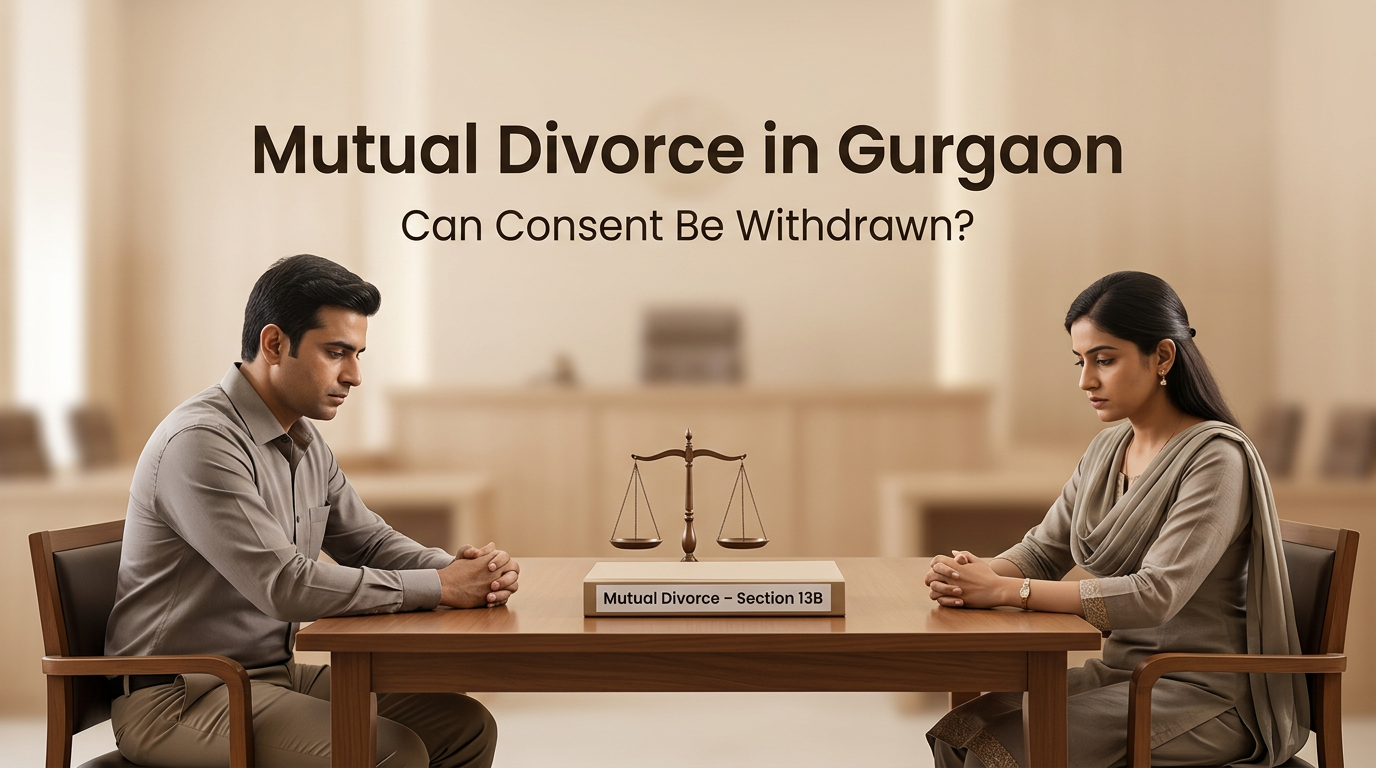
Mutual consent divorce is considered the most efficient and least adversarial way to dissolve a marriage in India. Governed by Section 13B of the Hindu Marriage Act, 1955, it allows spouses to separate amicably when they are unable to continue their marital relationship.
However, a critical legal question often arises:
Once a mutual divorce petition is filed, can one spouse withdraw consent before the final decree?
This issue was decisively settled by the Supreme Court in Sureshta Devi v. Om Prakash (1991) 2 SCC 25, a landmark judgment that continues to guide matrimonial courts across India.
Legal Framework of Mutual Divorce
Under Section 13B, mutual divorce follows a two-stage process:
- First Motion:
Both spouses jointly file a petition stating that they have been living separately for at least one year and mutually agree to dissolve the marriage.
- Second Motion:
After the statutory period, both parties must again appear before the court and confirm their consent. Only then can the court grant a divorce decree.
The key takeaway here is that consent is not a one-time formality, it must persist throughout the process.
Facts of Sureshta Devi v. Om Prakash
In this case:
- The husband and wife jointly filed for mutual divorce
- The first motion was completed successfully
- Before the second motion, the wife withdrew her consent
- The husband argued that the court should still grant divorce since the petition had already been filed
This conflict led to a crucial legal question before the Supreme Court.
Key Legal Issue
The Court had to determine:
- Can consent be withdrawn after filing a mutual divorce petition?
- Is the first motion sufficient to grant divorce?
Supreme Court’s Ruling
The Supreme Court gave a clear and definitive answer:
- Consent can be withdrawn at any time before the final decree
- Mutual consent must continue until the second motion stage
- If consent is withdrawn, the court cannot grant divorce under Section 13B
Reasoning of the Court
The judgment is rooted in the fundamental nature of mutual divorce. The Court emphasized:
- Mutual divorce is based on free and voluntary agreement
- Consent must exist at every stage of the proceedings
- The court must be satisfied about consent at the time of passing the decree
In essence:
- Filing a petition reflects intention, not final commitment
- Without continued consent, the divorce loses its mutual character
Legal Principle Established
This judgment established a binding principle:
- Mutual consent must be continuous, not conditional or temporary
- If either spouse withdraws consent before the second motion:
- The petition fails
- The court cannot proceed with mutual divorce
Supporting Judicial Position
This principle has been reaffirmed in subsequent cases:
- Hitesh Bhatnagar v. Deepa Bhatnagar (2011):
The Supreme Court held that divorce cannot be granted if consent is withdrawn before the decree.
- Amardeep Singh v. Harveen Kaur (2017):
While the Court allowed waiver of the cooling-off period, it did not dilute the requirement of continuous consent.
Practical Implications
This legal position has important real-world consequences:
- Many mutual divorce cases fail at the second motion stage
- A change in mindset, emotional reconsideration, or dispute over settlement can halt the process
- In such situations, parties must explore contested divorce under valid legal grounds such as:
- Cruelty
- Desertion
- Adultery
Common Misconception
A frequent misunderstanding among litigants is:
- Filing a mutual divorce petition guarantees divorce
In reality:
- The final decision lies at the second motion stage
- Consent at that point is legally decisive.
Strategic Legal Insight
Before filing for mutual divorce, it is important to ensure:
- Settlement terms are clearly finalized
- Both parties are mentally and legally prepared
- There is no coercion or external pressure
- Issues related to alimony, custody, and property are resolved
A lack of clarity at this stage often leads to breakdown at the final stage.
Conclusion
The ruling in Sureshta Devi v. Om Prakash reinforces a fundamental principle of matrimonial law:
Mutual divorce is not just about agreement—it is about continued agreement until the very end.
If consent is withdrawn before the final decree:
- The court has no authority to grant divorce under Section 13B
This ensures that mutual divorce remains truly voluntary and protects individuals from being compelled into a decision they no longer support.
About Family Kanoon
At Family Kanoon, under the guidance of Adv. Gaurav Kashyap, we specialize exclusively in matrimonial and family law matters. Our approach focuses on:
- Structuring legally sound mutual divorce settlements
- Advising clients on strategic decision-making before filing
- Handling contested divorce cases with clarity and precision
- Ensuring compliance with the latest judicial precedents
Whether you are considering mutual divorce or facing a complex matrimonial dispute, professional legal guidance can make the process smoother, faster, and legally secure.